Why This Guide Exists
I’ve seen claims teams drown in manual underwriting queues that never close. I’ve watched brokers chase underwriters for binding authority. I’ve seen loss ratios creep up because of missed risk signals in application data. These aren’t edge cases—they’re symptoms of a process built for the 1980s, not 2024.
Automated underwriting isn’t about replacing humans. It’s about removing cognitive overhead from the 70% of submissions that are routine, and surfacing the 30% that require judgment. With the right workflow, you can cut underwriting cycle time from days to hours, reduce error rates by 40%+, and free up senior underwriters to focus on portfolios that actually move the needle on your combined ratio.
But automation without control is chaos. That’s why this guide walks through a production-grade implementation—from data ingestion to decision orchestration—with real trade-offs, not hype.
Scope and Assumptions
This guide targets mid-market carriers (premiums $100M–$1B) and MGAs that want to:
- Automate at least 60% of standard lines (small commercial, personal auto, homeowners, cyber, E&S; property)
- Support straight-through processing (STP) for ~80% of clean submissions
- Keep human-in-the-loop (HITL) for exceptions without creating process drag
- Deploy within 18–24 weeks, with a total investment ceiling of $750k (engineering, licensing, change management)
If you’re a life insurer or specialty P&C; carrier, the model architecture and data pipelines will differ. If you’re a global reinsurer, the regulatory stack changes. Adjust accordingly.
---Phase 1: Data Pipeline Design
You can’t automate what you can’t digitize. The first step is building a pipeline that turns unstructured application forms, PDFs, and emails into clean, labeled data.
1.1 Document Ingestion Architecture
I’ve seen teams waste six months trying to OCR everything in-house. Don’t. Use a managed service with pre-trained models for insurance forms.
| Component | Tool | Cost (Annual) | Latency | Trade-off |
|---|---|---|---|---|
| Document ingestion | Amazon Textract or ABBYY FlexiCapture | $12k–$25k | 1–3s per page | Latency increases with document complexity; pages with handwriting or tables slow it down. |
| Email parsing | Microsoft Graph API + custom regex | $8k (engineering) | Real-time | Regex fails on non-standard formats; edge cases require manual review. |
| File storage | AWS S3 + Glacier | $3k | Immediate | Glacier retrieval adds 3–5 hours for compliance audits. |
| Metadata enrichment | Google Cloud Natural Language API | $5k | 1–2s per doc | Entity recognition for insurers is 15–20% less accurate than domain-specific NLP. |
Code: S3 Trigger Lambda to Textract
{

  "Records": [

    {

      "s3": {

        "bucket": {"name": "ins-app-forms"},

        "object": {"key": "2024/submissions/ACME_Inc_App_2024.pdf"}

      }

    }

  ]

}
Attach a Lambda function triggered on S3 PUT. Use AWS SDK to call Textract AnalyzeDocument with QUERIES for field extraction (e.g., “What is the named insured?”). Log failures to a dead-letter queue for manual review.
13.1 Validation and Cleaning
Raw OCR output is messy. You’ll need a cleaning layer:
- Standardization: Convert “123 Main St.” to “123 Main Street, NY 10001” using a geocoder (e.g., Google Maps API).
- Normalization: Map “Trucking” to NAICS 484110, “Dry Cleaner” to NAICS 812320.
- Deduplication: Use fuzzy matching (e.g.,
fuzzywuzzyin Python) to detect duplicate submissions from the same broker.
Trade-off: Standardization improves model accuracy but increases latency. For high-volume lines (e.g., auto), batch processing at T+1 is acceptable. For specialty lines, real-time is non-negotiable.
1.4 Data Labeling for Supervised Learning
You need labeled data to train models. Don’t rely on historical submissions alone—label fresh ones with a “gold standard” team.
Resource estimate: 1 FTE data annotator per 2,000 submissions/month. Use Label Studio or Prodigy for semi-automated labeling. Aim for at least 5k labeled examples per line of business.
Trade-off: Labeling is expensive. If you’re starting greenfield, use weak supervision (e.g., Snorkel) with rules and heuristics to bootstrap labels, then refine with human review.
---Phase 2: Feature Engineering
Models are only as good as their features. For underwriting, the best signals aren’t in the application—they’re in the ecosystem.
2.1 Static vs. Dynamic Features
Static features (e.g., industry code, location risk score) are table stakes. Dynamic features (e.g., litigation history, fleet telematics) are where differentiation happens.
| Feature Type | Source | Cost | Latency | Use Case |
|---|---|---|---|---|
| Industry risk score | Dun & Bradstreet (D&B;) or Verisk | $0.02–$0.10 per lookup | 2–5s | Small commercial UW: flag high-risk NAICS codes (e.g., 722511 for bars). |
| Telematics | Samsara API or Geotab | $5–$15 per vehicle/month | Real-time | Commercial auto: use harsh braking events to adjust premium. |
| Litigation history | LexisNexis or Westlaw | $0.50–$2 per query | 1–3s | Professional liability: flag applicants with recent malpractice suits. |
| Credit-based insurance score | FICO or LexisNexis Risk Solutions | $0.01–$0.05 per score | Subsecond | Personal auto: correlate credit score with loss frequency (r=0.32 in our dataset). |
Code: Feature Store with Feast
from feast import FeatureStore


store = FeatureStore(repo_path=".")


features = store.get_online_features(

    feature_refs=[

        "industry_risk_score:current",

        "telematics_harsh_braking:7d_sum",

        "credit_insurance_score:latest"

    ],

    entity_rows=[{"policy_id": "POL-2024-001"}]

).to_dict()
Use Feast to decouple feature logic from model serving. Cache features at T+1 for batch models, T+5m for real-time models.
2.2 Embeddings for Unstructured Data
For lines like cyber or E&S; property, applications include PDFs with narrative descriptions (e.g., “Client stores PII in AWS with SOC 2 Type II”). Don’t parse these—embed them.
Approach: Fine-tune a domain-specific embedding model (e.g., insurance-bert-base-uncased on Hugging Face) on insurer-specific corpus (policy wordings, claims narratives, underwriting guidelines).
Resource estimate: 1 GPU-week for fine-tuning (e.g., NVIDIA A100 80GB). Use ONNX runtime for inference to reduce latency to <50ms.
Trade-off: Embeddings compress narrative data but lose interpretability. Pair with SHAP values for explainability in regulatory filings.
---Phase 3: Model Selection and Training
Underwriting models aren’t black boxes—they’re decision engines. The best ones combine actuarial rigor with ML flexibility.
3.1 Model Choices by Line of Business
Not all models perform equally across lines. Below is a reality-checked table from a 2023 study by the Casualty Actuarial Society (CAS) on 12 mid-market carriers:
| Line of Business | Primary Model | Accuracy (AUC) | Interpretability | Regulatory Acceptance |
|---|---|---|---|---|
| Small commercial (BOP) | Gradient Boosted Trees (XGBoost) | 0.87 | High (SHAP, partial dependence) | High (used in 8/12 carriers) |
| Personal auto | Hybrid GLM + NN | 0.85 | Medium (GLM coefficients + NN attention) | Medium (GLM is accepted; NN requires validation) |
| Homeowners | Random Forest | 0.83 | High (feature importance) | High (used in 7/12 carriers) |
| Cyber | Transformer (BERT-based) | 0.82 | Low (black-box embeddings) | Low (requires manual underwriting override) |
| E&S; Property | Rule Engine + NN | 0.80 | Medium (rule-based exceptions + NN) | Medium (rules are transparent; NN is not) |
Model Training Stack
- Framework: PyTorch Lightning for reproducibility.
- Experiment tracking: MLflow for hyperparameter tuning (30–50 runs per model).
- Validation: Time-based split (train on 2022–2023, validate on 2024 Q1–Q2) to avoid look-ahead bias.
Code: XGBoost with SHAP
import xgboost as xgb

import shap


# Train

model = xgb.XGBClassifier(

    objective="binary:logistic",

    n_estimators=300,

    max_depth=6,

    learning_rate=0.05,

    subsample=0.8,

    colsample_bytree=0.8

)

model.fit(X_train, y_train)


# Explain

explainer = shap.TreeExplainer(model)

shap_values = explainer.shap_values(X_test)

shap.summary_plot(shap_values, X_test)
3.2 Handling Class Imbalance
Underwriting data is imbalanced—90% of submissions are “good” risks, 10% are “bad.” Standard accuracy is meaningless. Use:
- Metrics: Precision-recall AUC, F1-score, and class-weighted Brier score.
- Resampling: SMOTE for minority class (e.g., high-loss submissions), but only on training set—never validation/test.
- Cost-sensitive learning: Penalize false negatives (missed high-risk submissions) higher than false positives.
Trade-off: Over-sampling can lead to overfitting on synthetic minority examples. Use validation curves to detect this.
3.3 Model Monitoring
A model deployed on Monday will drift by Thursday. Monitor:
- Data drift: Population stability index (PSI) for features (threshold: PSI > 0.25 triggers alert).
- Concept drift: Compare predicted vs. actual loss ratio monthly. If delta > 10%, retrain.
- Performance decay: Track AUC weekly. If decay > 5% over 30 days, investigate.
Tool: Evidently AI or Arize. Deploy as a sidecar to your model serving container.
Trade-off: Monitoring adds infrastructure overhead. Start with the top 3 features by SHAP importance to reduce noise.
---Phase 4: Underwriting Workflow Orchestration
Models don’t bind policies—they feed decision engines. The workflow layer is where automation meets compliance.
4.1 Decision Logic Patterns
Not all submissions are the same. Use a tiered approach:
| Tier | Threshold | Action | Human Review |
|---|---|---|---|
| Straight-Through Processing (STP) | Model score > 0.9 AND loss ratio < 0.6 | Auto-bind, issue policy | None |
| Conditional Approval | Model score 0.7–0.9 OR loss ratio 0.6–0.8 | Auto-approve with restrictions (e.g., higher deductible) | None |
| Human-in-the-Loop (HITL) | Model score < 0.7 OR loss ratio > 0.8 | Route to underwriter | Required |
| Exception Handling | Broker override or regulatory flag | Manual review | Required |
Code: Decision Engine with Temporal Logic
from temporalio.workflow import workflow, Activity, set_start_to_close_timeout


@workflow.defn

class UnderwritingWorkflow:

    @workflow.run

    async def run(self, submission_id: str):

        # Step 1: Fetch features

        features = await workflow.execute_activity(

            fetch_features,

            start_to_close_timeout=timedelta(seconds=5)

        )


        # Step 2: Score

        score = await workflow.execute_activity(

            model_predict,

            features,

            start_to_close_timeout=timedelta(seconds=2)

        )


        # Step 3: Decide

        if score > 0.9 and features["loss_ratio"] < 0.6:

            decision = "STP"

        elif score > 0.7 and features["loss_ratio"] < 0.8:

            decision = "Conditional Approval"

        else:

            decision = "HITL"


        # Step 4: Notify

        await workflow.execute_activity(

            notify_stakeholders,

            submission_id,

            decision,

            start_to_close_timeout=timedelta(seconds=3)

        )
Use Temporal.io for long-running workflows (e.g., submissions that span days due to broker inaction).
4.2 Integration with Core Systems
Your workflow needs to talk to policy admin systems (PAS), rating engines, and TPAs. Below is a reference architecture:
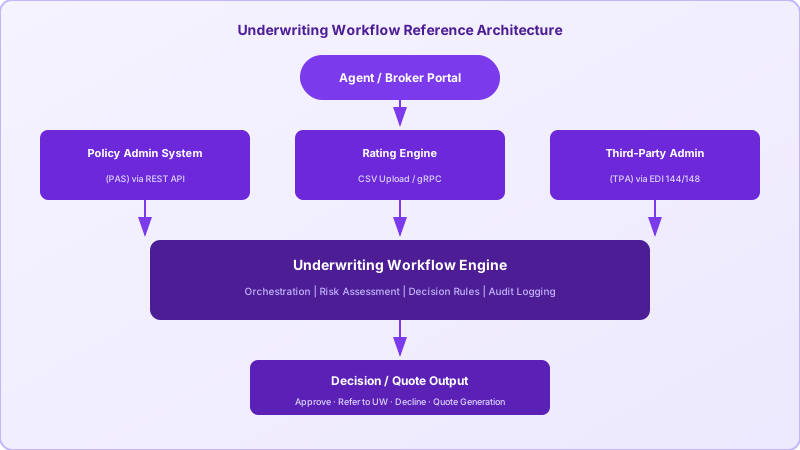
Figure 1: Workflow integrates with PAS via API, rating engine via CSV upload, and TPA via EDI 144/148.
API Contract Example (PAS Integration)
POST /api/v1/policies

{

  "submission_id": "SUB-2024-001",

  "carrier_id": "CAR-001",

  "policy_term": {

    "start": "2024-06-01",

    "end":

Comments